
AutoGen and Crewly both get described as multi-agent tools, and both are open source. They do different jobs: AutoGen is a library you write agents against, Crewly is a program that runs agents that already exist. One fact matters before any comparison: AutoGen is now in maintenance mode, and Microsoft points new users to a successor. This post sets out what AutoGen and that successor are, from their own pages as of 9 October 2026, and which kind of work fits which. It is not a ranking.
The short version
| AutoGen / Microsoft Agent Framework | Crewly | |
|---|---|---|
| What it is | Frameworks for building multi-agent applications in code | An open-source orchestrator for a standing team of CLI agents |
| Status | AutoGen is in maintenance mode; Microsoft Agent Framework is the successor it recommends for new projects | Current release on GitHub and npm |
| You work in | Code, in Python or .NET | A dashboard, Slack and plain-language requests |
| Where the agents come from | You build them from model clients and tools | Existing CLIs: Claude Code, Codex, Gemini CLI, OpenCode and Antigravity, mixed per agent |
| Who delegates | Patterns you write, such as group chats, handoffs and workflows | A lead agent splits a request and hands out tasks |
| Run it | pip install -U "autogen-agentchat" "autogen-ext[openai]", or pip install agent-framework | One-line installer, then crewly start |
| Licence | MIT (AutoGen code) | MIT |
| Best at | Building a multi-agent application that is part of your own product | Getting a team of coding and business agents working without writing orchestration code |
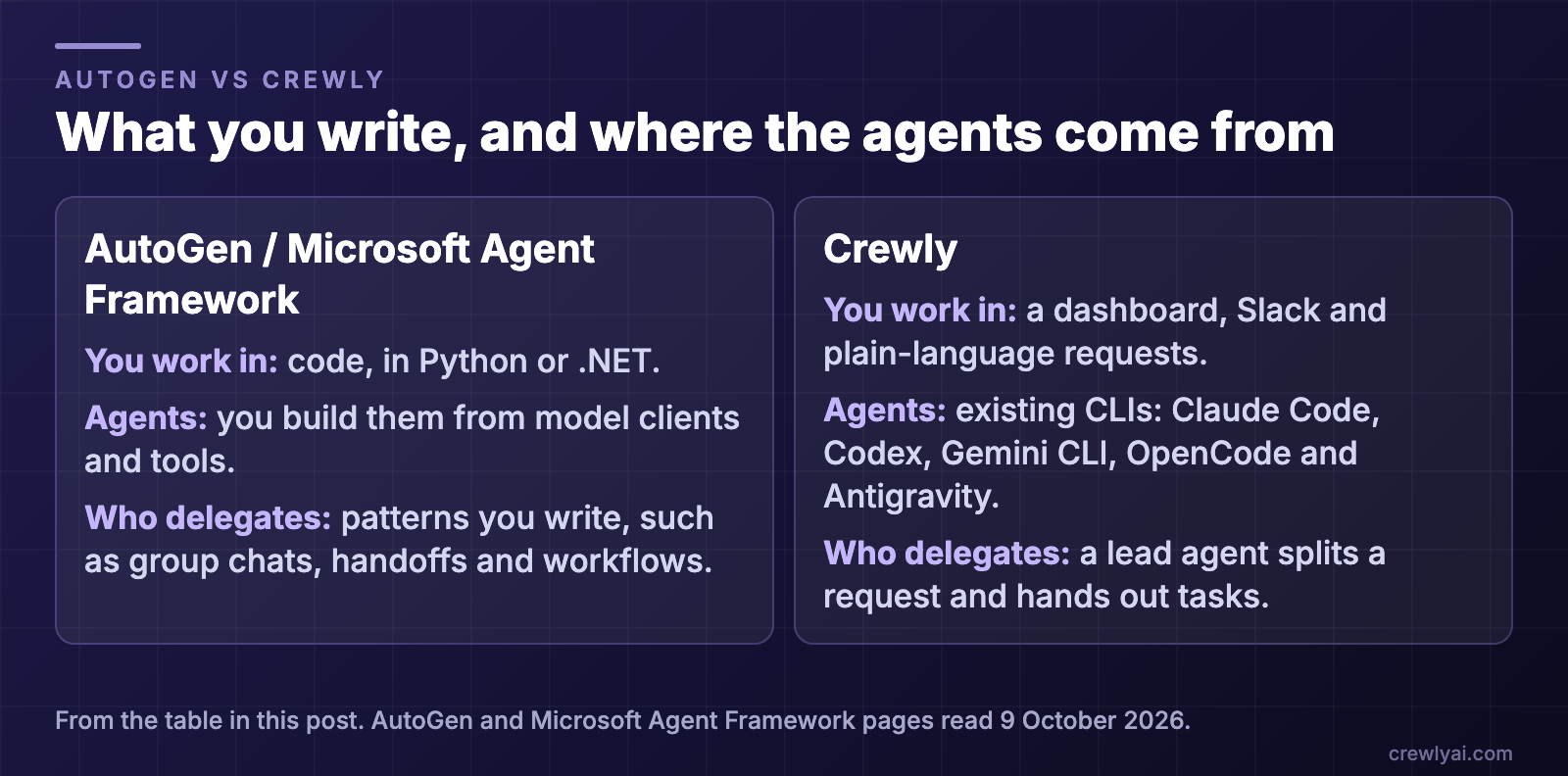 Diagram: what you write and where the agents come from. AutoGen and Microsoft Agent Framework: you work in code, in Python or .NET, you build the agents from model clients and tools, and delegation follows patterns you write. Crewly: you work in a dashboard, Slack and plain-language requests, the agents are existing CLIs, and a lead agent splits a request and hands out tasks.
What are AutoGen and Microsoft Agent Framework?
The AutoGen README describes it as "a framework for creating multi-agent AI applications that can act autonomously or work alongside humans". It then carries a notice: "AutoGen is now in maintenance mode. It will not receive new features or enhancements and is community managed going forward." and says "New users should start with Microsoft Agent Framework." A migration guide is linked for existing users.
How AutoGen works, from its README:
- Layers. A Core API implements "message passing, event-driven agents, and local and distributed runtime"; an AgentChat API is described as "simpler but opinionated" for rapid prototyping; an Extensions API adds model clients and capabilities such as code execution.
- Agents you define in code. The quickstart creates an
AssistantAgentwith a model client, and shows a multi-agent setup in which specialist agents are wrapped as tools for a general assistant. - AutoGen Studio. A no-code GUI for prototyping workflows, which the README says is "not meant to be a production-ready app".
Microsoft Agent Framework is the successor. Its README calls it "an open, multi-language framework for building production-grade AI agents and multi-agent workflows" in .NET and Python, and says it provides "a consistent foundation for building, orchestrating, and operating agent systems". Among its listed features are "graph-based workflows supporting sequential, concurrent, handoff, and group collaboration patterns; includes checkpointing, streaming, human-in-the-loop, and time-travel", middleware, OpenTelemetry observability and hosting on Microsoft Foundry. It lists support for "Microsoft Foundry, Azure OpenAI, OpenAI, and the GitHub Copilot SDK".
What the Microsoft frameworks do well
- Control inside your application. You decide the agents, the tools and how they hand work to each other, in code.
- Production features for application builders. In Agent Framework: checkpointing, human-in-the-loop, observability and hosting options.
- Two languages. Python and .NET.
- A company behind the successor. Microsoft describes Agent Framework as the one with long-term support.
What the pages we read do not describe
They describe agents you build in code from model clients and tools. They do not describe a ready-made team of named roles, or running CLI coding agents such as Claude Code or Codex as the agents. That is not a flaw: these are frameworks, and what you build with them is up to you.
Where Crewly fits
Crewly starts from the other end. You do not write the orchestration; you define a team, and the agents are CLIs you may already use.
- A standing team. You define roles once (an orchestrator, a team lead, developers, a QA, or a content or sales role) and the team and each agent's memory are saved under
~/.crewly/, so they survive a restart. - A lead that delegates. A lead agent splits a request into tasks, hands them out, and checks the result before it is closed.
- Existing agents, mixed. Claude Code, Codex, Gemini CLI, OpenCode and Antigravity, each in its own terminal session, each able to use a different CLI.
- Agents build their own memory. They save what they learn with a
rememberskill and read it back withrecall, as plain files on your machine. - A dashboard and Slack. Live terminal streams and a task board in the browser, and an optional Slack bridge in which each agent can have its own bot you
@or DM. See Claude Code Slack bot for every agent.
Two honest limits. Crewly is not a library: you cannot import it to build a custom application, and what the agents do is whatever their CLIs can do. And by default its agents share the project directory, so if you want a branch per task you turn on the per-project worktrees setting.
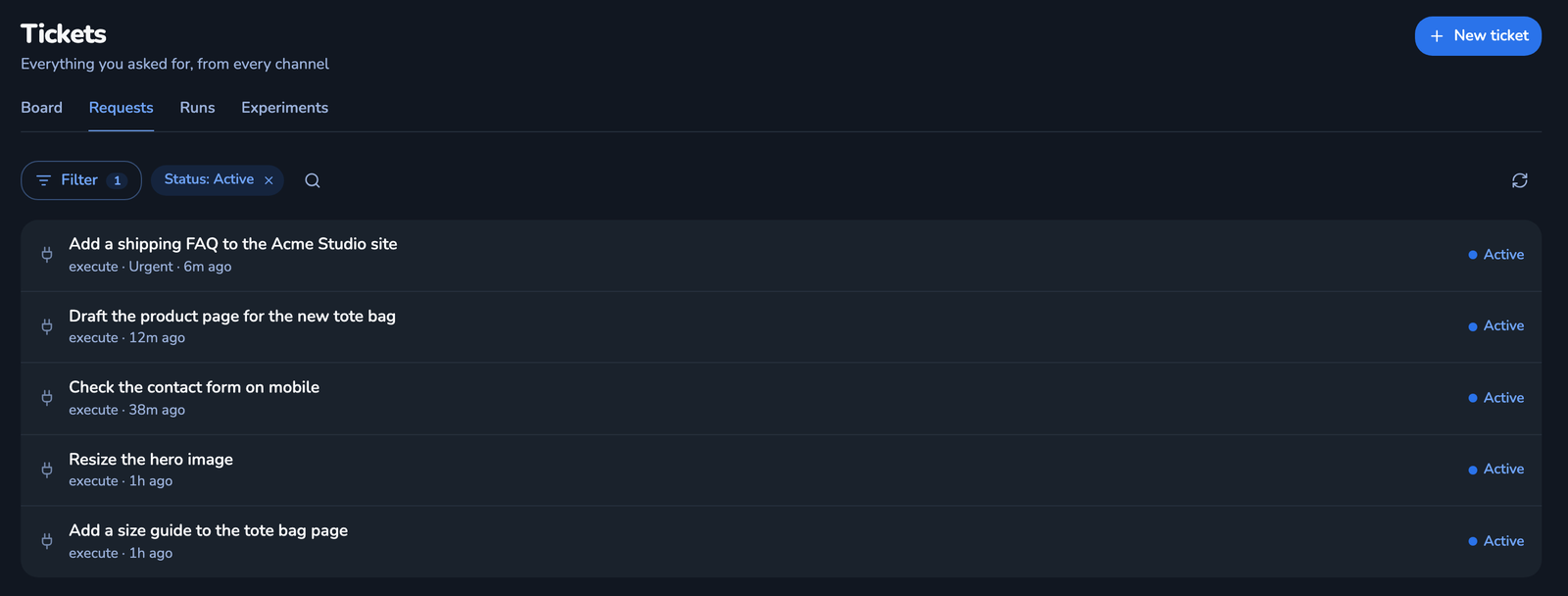 Screenshot of the Tickets page in the Crewly dashboard, Requests tab, with demo data: five active requests, such as "Add a shipping FAQ to the Acme Studio site" (6m ago) and "Draft the product page for the new tote bag" (12m ago).
Which should you pick?
- You are building a multi-agent application in code, in Python or .NET: Microsoft Agent Framework, which is where Microsoft sends new projects. If you already run AutoGen, the README links a migration guide.
- You want a team of Claude Code, Codex and other agents working on your projects, with roles and memory, and no orchestration code to write: Crewly.
- Both: fine. They sit at different layers.
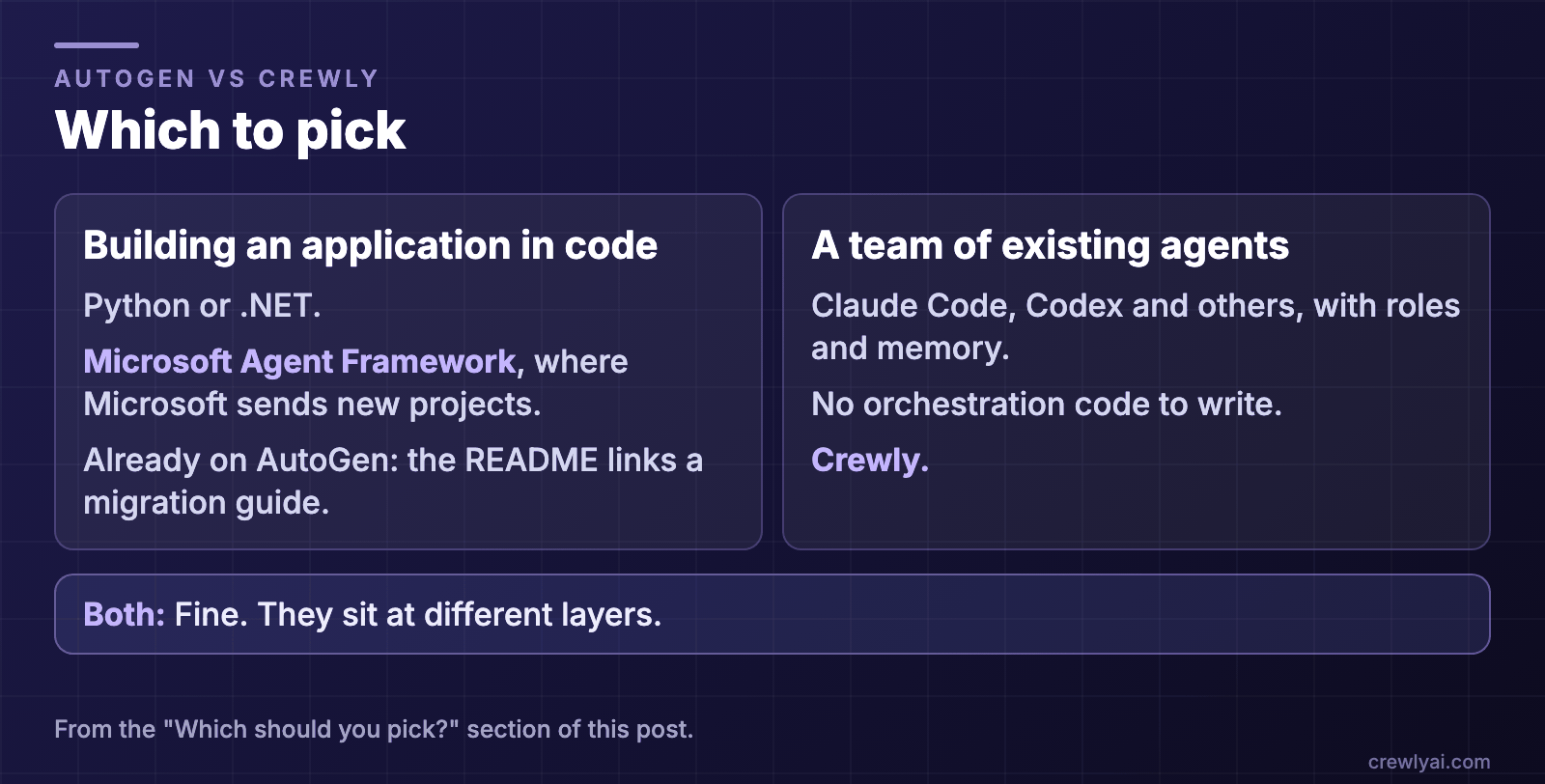 Diagram: which to pick. Building an application in code, in Python or .NET: Microsoft Agent Framework. A team of existing agents with roles and memory and no orchestration code to write: Crewly. Both is fine, since they sit at different layers.
To try Crewly, install Node.js 22 or newer first (the installer from nodejs.org, or Homebrew / your package manager), then run:
curl -fsSL https://crewlyai.com/install.sh | bash
Open a new terminal and run:
crewly start
Prefer npm? npm install -g crewly works if your Node comes from Homebrew or the nodejs.org installer.
crewly start opens the dashboard at http://localhost:8787. The getting started guide covers your first team, and How to run multiple agents in Claude Code compares worktrees, subagents, agent teams and an orchestrator. For other comparisons, see LangGraph vs Crewly, OpenHands vs Crewly and Conductor vs Crewly.
FAQ
What is Microsoft AutoGen?
AutoGen is an open-source framework from Microsoft. Its README describes it as "a framework for creating multi-agent AI applications that can act autonomously or work alongside humans". You write the agents in Python or .NET.
Is AutoGen still maintained?
Its README says: "AutoGen is now in maintenance mode. It will not receive new features or enhancements and is community managed going forward." It tells new users to start with Microsoft Agent Framework, and links a migration guide for existing users.
How is AutoGen different from Crewly?
AutoGen is a library you write multi-agent applications against. Crewly is a program you run: it starts ready-made CLI agents such as Claude Code and Codex, gives each a role, and lets a lead agent delegate between them. The same split applies to Microsoft Agent Framework.
Can AutoGen or Microsoft Agent Framework run Claude Code or Codex?
The AutoGen and Microsoft Agent Framework READMEs we read do not describe running Claude Code or Codex CLIs as agents. Microsoft Agent Framework's README lists the GitHub Copilot SDK among the providers it supports. Crewly starts Claude Code, Codex, Gemini CLI, OpenCode and Antigravity directly, each in its own terminal session.
Can I use both?
Yes. They sit at different layers. If you are building an agent application in code, use the Microsoft framework. If you want a team of existing coding agents working on your projects, Crewly runs them.
Sources
All facts about AutoGen and Microsoft Agent Framework are from their own pages, read on 9 October 2026: the AutoGen repository README and the Microsoft Agent Framework repository README. We do not repeat prices, star counts or benchmark claims; check the pages. Crewly: repository, crewlyai.com.