
Vibe Kanban gave a lot of people their first calm way to run several coding agents at once: cards on a board, one workspace per card, review when the agent is done. In April its company announced it was shutting down. This post sets out what that does and does not change, based on the project's own announcement and README as of 8 October 2026, and where Crewly fits if you are looking around.
The short version
- Your local setup still works. The announcement says "local workspaces will continue to function."
- The hosted parts are gone. Kanban issues, comments, projects and organizations were removed after a 30-day window.
- The code lives on. The project is described as "open source and community maintained," and the repository is Apache-2.0.
- You have three honest options: stay on the local version, follow the community edition, or move to something else.
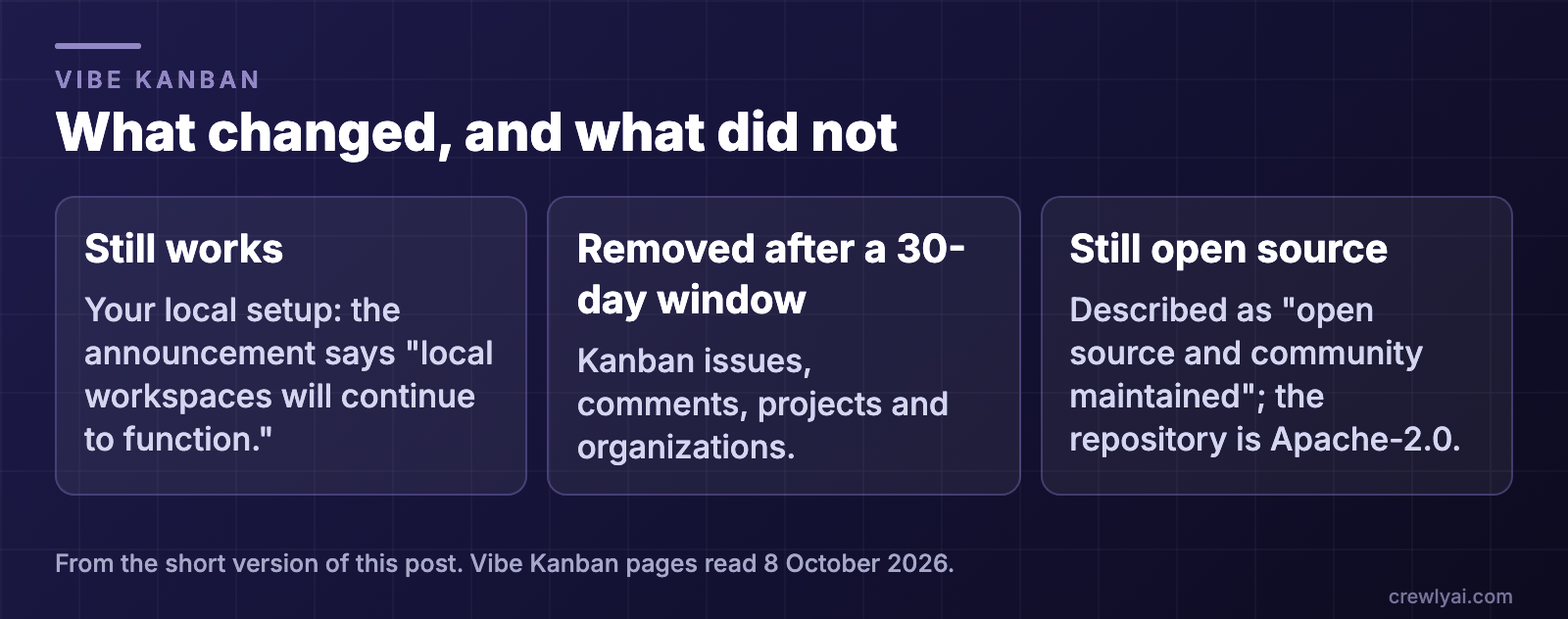 Diagram: what changed and what did not. Still works: local workspaces, per the announcement. Removed after a 30-day window: Kanban issues, comments, projects and organizations. Still open source: described as open source and community maintained, with an Apache-2.0 repository.
What happened
On 10 April 2026 the team behind Vibe Kanban, Bloop, announced it was shutting the company down. Their stated reason: "we couldn't find a business model that we could get excited about," with most users on free plans.
What changed for users, in the announcement's words:
- "Remote services will remain available for 30 days, after which Vibe Kanban will transition to a fully local architecture." The services removed were kanban issues, comments, projects and organizations.
- "For the avoidance of doubt, local workspaces will continue to function."
- The latest version includes a data export feature.
- Refunds were issued for invoices paid in the previous 30 days, and subscriptions were ended.
- The project will continue as open source, community maintained, and the team wrote that they "believe there is a non-commercial future for the project."
The README now opens with "Vibe Kanban is sunsetting." It still describes the tool as a way to plan work with kanban issues and then create workspaces where agents run it, with each workspace giving an agent "a branch, a terminal, and a dev server." It lists support for 10+ agents, including Claude Code, Codex, Gemini CLI, GitHub Copilot, Amp, Cursor and OpenCode. On 8 October the repository showed about 28,300 stars.
Your three options
1. Stay on the local version
If Vibe Kanban already does what you need, the announcement says local workspaces keep working. Run npx vibe-kanban as before. The cost is the unknown: with no company behind it, new agent versions, bug fixes and security patches depend on volunteers. Export your data now while the export feature exists.
2. Follow the community edition
The team said a roadmap for the community-maintained edition would follow. Check the repository and vibekanban.com for it before you commit. The licence is Apache-2.0, so forking is allowed if you have the appetite to maintain it.
3. Move to another tool
This is where the choice depends on what you liked about Vibe Kanban. If it was the board, look for another board-first tool. If it was running several agents in parallel without collisions, then any tool that gives each agent its own checkout does that. If you want agents that keep working and remembering as a team, that is a different shape of tool.
Where Crewly fits
Crewly is an open-source (MIT) orchestrator built around a standing team rather than a board of cards.
| Vibe Kanban | Crewly | |
|---|---|---|
| Core idea | You plan cards, then start an agent workspace for each | You define roles once; a team lead delegates, and each agent keeps its own role and memory |
| Who moves the work | You, from the board | A lead agent, and you from a dashboard or Slack |
| Agents | 10+ listed in the README | Claude Code, Codex, Gemini CLI, OpenCode and Antigravity, mixed per agent |
| Isolation | A branch per workspace | Agents share the project directory by default; per-task git worktrees are an opt-in setting per project |
| Memory | Not described in the README | Each agent's memory saved under ~/.crewly/ and kept across restarts |
| Beyond code | Coding agents | The same team model also runs content, research and sales roles |
| Status | Sunsetting; local use, community maintained | Actively developed |
| Licence | Apache-2.0 | MIT |
Two honest differences. Crewly is not a kanban-first tool: it has a dashboard with a task board and live terminal views, but you are not expected to drag cards to start each job. And it supports fewer agent programs than Vibe Kanban's list, so if you rely on one of the others, check before you move.
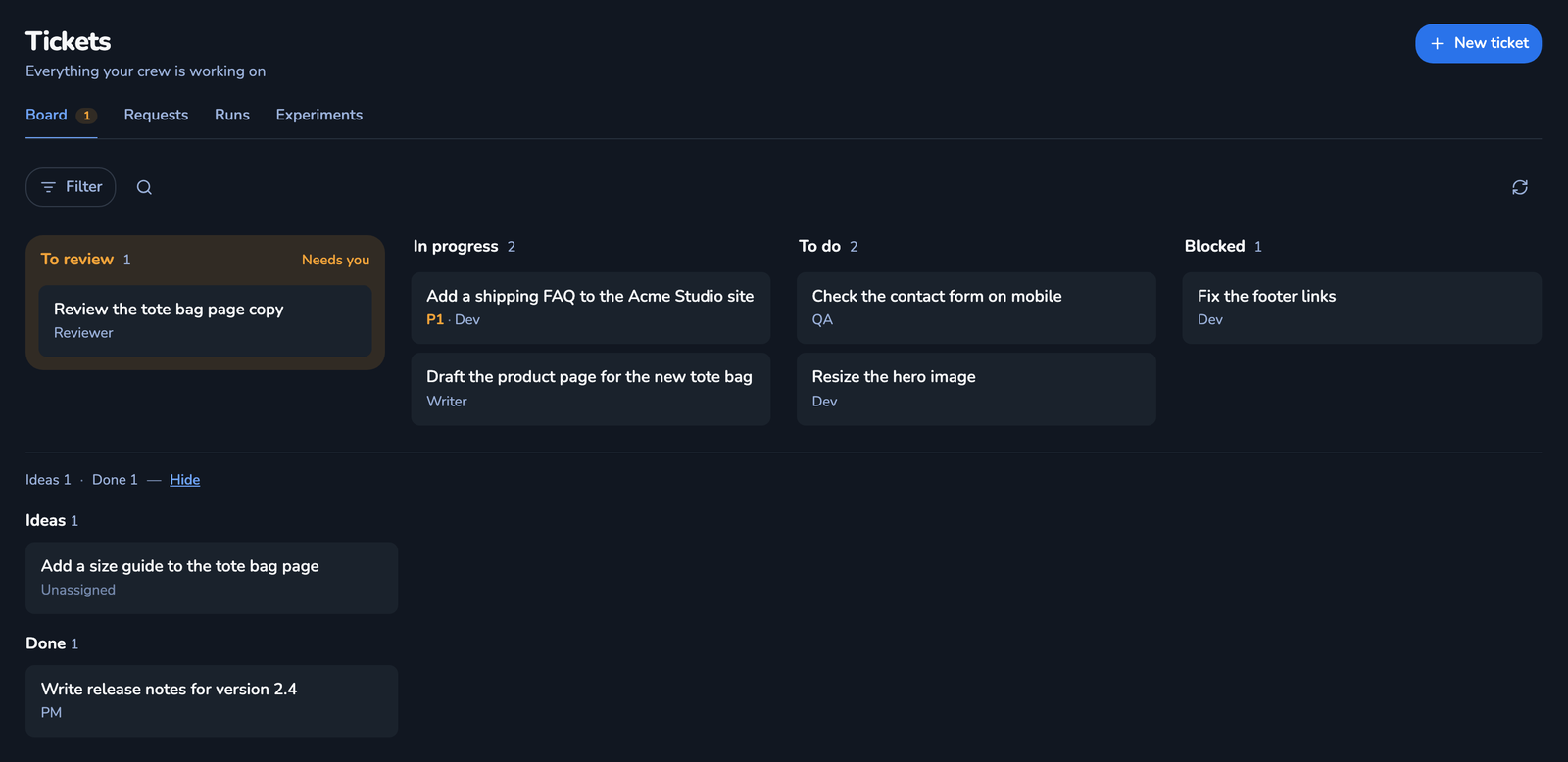 Screenshot of the Tickets board in the Crewly dashboard, with demo data: tickets in To review, In progress, To do and Blocked, plus an Ideas list and a Done list, each ticket with its assignee.
Which should you pick?
- You want the same board, nothing new to learn: stay local, export your data, and watch the community roadmap.
- You want parallel isolated workspaces and a board: look at the other board-first tools and check each one's own page for what it is.
- You want a team that keeps working across days, with roles and memory, from a dashboard or Slack: try Crewly.
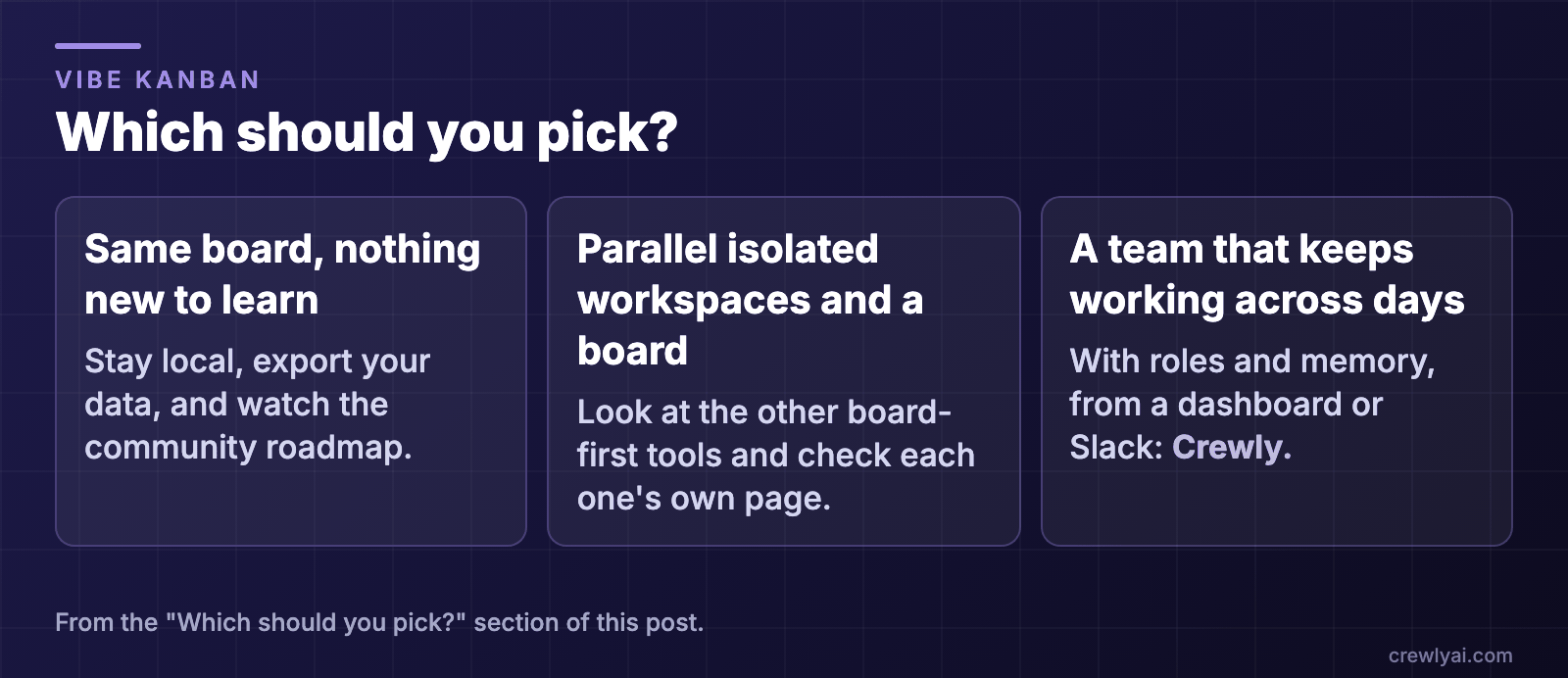 Diagram: which to pick. Same board and nothing new to learn: stay local, export your data and watch the community roadmap. Parallel isolated workspaces and a board: look at the other board-first tools and check each one's own page. A team that keeps working across days, with roles and memory, from a dashboard or Slack: Crewly.
To try it, install Node.js 22 or newer first (the installer from nodejs.org, or Homebrew / your package manager), then run:
curl -fsSL https://crewlyai.com/install.sh | bash
Open a new terminal and run:
crewly start
Prefer npm? npm install -g crewly works if your Node comes from Homebrew or the nodejs.org installer.
crewly start opens the dashboard at http://localhost:8787. The getting started guide walks through your first team, and How to run multiple agents in Claude Code compares the other ways to run them in parallel.
Sources
All facts about Vibe Kanban are from its own pages, read on 8 October 2026.
- Shutdown announcement: vibekanban.com/blog/shutdown (10 April 2026)
- README, licence and star count: github.com/BloopAI/vibe-kanban
- Crewly: repository, crewlyai.com